Stories
Religions
Different faiths - one place
Freedom of religion in Transylvania
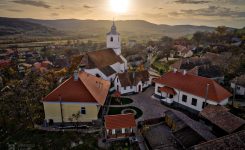
On 1 November, at All Saints’ Day, hundreds of people come to the two hillside cemeteries of Cristuru Secuiesc after dark. Hardly anyone speaks a word, they all bring candles to the graves of their relatives and turn the mountain into a flickering sea of lights. It is originally a Catholic custom: the saints of the Bible are to be celebrated, while at the same time the dead family members should be remembered. The latter, however, has now also been adopted by the other confessions in Transylvania. In addition to the small Orthodox and Catholic communities, there is also a Calvinist and a Unitarian church in the town – together they visit the shared cemetery. This is unusual for me. Although church gardens in Germany are open to all faiths, the different customs are usually celebrated separately. Furthermore, outside the cities, it is easy to divide into large Catholic and Protestant regions.
Why can one find here a heterogeneity of the religions?
In the Middle Ages, the forming Hungarian Empire settled the Szekler and German-speaking ethnic groups (“Saxons”) as its guardians at the borders of the Carpathian Basin, which were granted a special status inside the kingdom. The Transylvanian estates were organized in a „Landtag“ (Kind of a parliament). Excluding the Romanians, they called themselves the “unio trium nationum”, consisting of the Hungarian nobility with 7 counties, the royal lands of the Saxons with 7 chairs and 7 Szekler chairs. Outside the Diet, the ethnic groups were among themselves (even geographically) – “Transylvania” was merely the next largest administrative unit for ordinary people. The Battle of Mohacs in 1526 brought a change: after Hungary had been defeated by the Ottoman Empire, the region became an autonomous principality. Though tributary to the Turks, but now independent of the Habsburgs, the Holy Roman Empire, and the Catholic Church, its own development had become possible.
Again and again, the Ottomans invaded, plundered farms, cleared fields, slaughtered cattle. The theologians at that time interpreted this as a “scourge of God” for false developments in the religion. One begins to question the faith, spiritual development begins – favorable condition for the fruit of reformatory ideas.
The implementation of the Reformation depended first of all on the ethnic groups. While the Transylvanian Saxons, since there was no university in the region, studied in Krakow, Basel, Nuremberg and mainly brought back Lutheran ideas, Hungarian students were more influenced by Calvin. Caspar Held took up Calvin’s teachings in Cluj-Napoca and transformed them into the Unitarian Church – at that time the only transethnic faith. The Szekler people, on the other hand, remained Roman Catholics.
Catholic Church:
– Lord’s Supper: Bread and wine are transformed into the body and blood of Jesus Christ
– Confession as liberation from sins
– Veneration of Mary and the Saints
– Seven Sacraments: Baptism, Confirmation, Eucharist, Penance, Anointing of the Sick, Marriage and Priestly Ordination
Reformed/Calvinist Church:
– the Lord’s Supper is merely a symbol, it is celebrated as a mere memorial celebration- Christening + Confirmation
– Keywords: Free Will, Reason in the Spirit of the Reformation
– ban on pictures, simple church rooms
– for Transylvania: based in Cluj-Napoca
Unitarian Church:
– similar to the Reformed Church, except one big difference: the doctrine of the Trinity is rejected
– God is spirit and love, Jesus is a man (not divine) and the Holy Spirit is a power
– Superintendent in Cluj-Napoca
In 1568 an up to then incomparable action happened: The Landtag of Torda decided on an interdenominational constitution, which recognized all four Christian religions. It was the first legally fixed religious freedom in Europe. At that time it was even theologically founded (Romans 10:17): “Thus faith is founded in the message, but the message in the word of Christ”. In other words, what God says may be interpreted differently by everyone. Today experts call the event a “special case” also for another reason: The spreading of the Reformation happened in the context of the state-guaranteed freedom of faith, but not by the state itself. In Germany, for example, the situation was completely different: There, during the Reformation, the principle “Cuius regio, eius relgio” (whose territory, whose religion) was followed for a long time. If the sovereign was a Lutheran, then the people may also be Protestant.
Today, almost half a millennium later, after wars, changes of power and territory (see also: HIKING WITH ZSOLT), Transylvania has kept many lively communities. After becoming Romanian, the region had lived through 40 years of communism and anti-religious politics until 1990. Nevertheless, this could not eradicate faith. 2005, 90% of the inhabitants of the secular (dividing state and church) republic of Romania said that they believed in God. Four out of five confessed to the Orthodox Church. In Cristuru Secuiesc, with 3200 members, the Calvinist community is the largest. Next comes the Unitarian Church with 2000 and the Catholic Church with about 1000. So the ethnic group still has some influence on the religion: with 2% Romanians in the town, the number of Orthodox is also negligible.
After All Saints’ Day, we decide to ask the pastors of the city for an interview. The Unitarian Csaba Tódor answers us first. He has only been in Cristuru Secuiesc for a few years and has just returned from a meeting with a partner parish in Boston. He describes the relationship to the other churches as lively, explicitly also to the Catholic denomination, which was the host of an ecumenical divine service this year. “The ecumenical week of prayer comprises 5 days. We go to Betfalva, Fiatfalva, every evening we go to different places to celebrate. Everywhere someone else speaks and prays and the whole community is there, we are together”, confirms the Catholic Peter Kovács. The Reformed pastor Zoltán Antal says without going into detail: “In the region, the relationship between the churches is very special and very good”.
They see problems elsewhere: The lost properties of the church during communism are given back too slowly by the state, complains Csaba Tódor. Zoltán Antal, who has been working in the parish for 30 years, a Hungarian flag on his desk, takes off in another direction: “My dilemma is: What can I do to make young adults understand and love religion and conservative values?” Then it becomes political again. “Why is our national holiday on 23 October (1956: Revolution in Hungary) important for me or the elderly? Or the regime change in the year 89? How can I share these life experiences with the youth?” Therefore, the municipality organizes events with information about history. “What does 1956 mean today? They didn’t know, I had to tell them.” At the end of the conversation, however, he returns to his values beyond history and politics. Parents should teach their children what is morally okay and what is not, he says. Then they have to grow up more and more independently. “Maybe they will fail, no matter, they will learn to deal with it, but they should not let themselves be manipulated. We must not control them. That is all.”
Thinking is up to each individual, and so faith should be free to choose. The 450 years of religious freedom in Transylvania are a good example that we have to remember.
If this story sparked your interest towards finding out more about Rural Transylvania and possible ways to experience it, you are welcome to contact us.
· Youth Association from Transylvania at office.ata@gmail.com
· Farmers Association from the Cristuru Secuiesc Area at office.aacs@gmail.com