Stories
Places full of history: Discovering Székelykeresztúr
Places full of history: Discovering Székelykerestúr
Part I
At the end of July 2021, we were visited in Székelykerestúr by members of three associations from Greece, France and Italy, to participate in a training organised by ATA in the context of the Rescue project, an international initiative for the revitalisation of abandoned public spaces. One of the activities we organised was a guided tour to learn about the history of the village, stopping at some of its most interesting buildings.
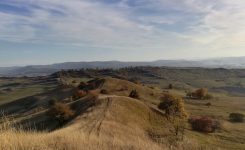
The town is very beautiful, surrounded by rolling hills and its architectural style is very striking for people who come from far away. It has a strong imprint of Hungarian architecture and a few Soviet-style buildings. Many low houses with gabled tiled roofs, large windows and pastel colours. Walking through the quiet and peaceful streets you can see that most of the houses have a large garden with wooden fences, often with vines, where people keep the custom of growing vegetables. It is also noteworthy how many people choose bicycles as a means of transport.
Let's start with a bit of history: the village was first mentioned in records from 1333 as Sancta Cruce. Its name is due to the fact that its church was built in honour of the Holy Cross. This name changed over time, in 1459 it was called Keresthwr, and it is not until 1630 that it appears in the records with its present name Székelykeresztúr. The present-day town grew out of the centre of Székelykeresztúr, to which the villages of Keresztúrfalva and Timafalva were added. Today it also includes Fiatfalva and Betfalva (in Hungarian the ending falva means village).The distinctive prefix Székely refers to Szeklerland, a territory historically occupied by the Hungarian minority in Transylvania. The Romanian name, Cristuru Secuiesc, is a translation based on the Hungarian model.This locality is located on the border between the Szekler territory and the Saxon (German minority) territory between the towns of Székelyudvarhely and Sighisoara (Schäßburg in German). Until the Treaty of Trianon in 1920, the village belonged to Hungary and was part of the Székelykeresztúr district of Udvarhely County, which then became part of Romania.
Many of the nooks of Kerestúr are full of history. Come with us to discover them:
It is very hot so we put on our hats to leave from the ATA office on the main street that runs through the whole town. We cross to the front side and head towards the town hall on the main square, located just a few metres away. This place was not always the seat of the local government but was formerly the Jakabházy house built as a private dwelling and in 1870, Szeklerland's only teacher training institute was located here. Due to its growth this institution moved in 1911 to a new building and the Girls' Civic School started to operate here until 1945. It finally became the town council in 1956. Further on we will see where the old town hall building was located.
If we go a little further we come to the library, this used to be a manor house in the 19th century that belonged to an Italian nobleman named Gusztáv Gamerra who moved here in 1840, as an officer in the imperial army, loyal to the Habsburgs, where he married Matskásy Krisztina, a member of one of the most renowned families in Keresztúr, so he was in charge of the family mansion that was located where the hospital is today. He was very active in the political life of the time and it is curious that he eventually embraced Hungarian nationalist ideas opposed to Habsburg interests. Before the battle of Sighisoara against the Imperial Russian army in 1849, Gamerra welcomed the Transylvanian army upon its arrival in the town, and according to some sources, he toasted the health of Lajos Kossuth, Hungary's leader during the 1848 revolution. He lived until the beginning of the 20th century.
In front of the library there is a bronze statue of the Romanian poet Nicolae Bălcescu, who had no connection with the village. The main reason for this statue being there is that in the 1970's permission was requested from the Romanian authorities to build a statue of Sándor Petőfi but as the poet was a symbol of Hungarian nationalism the condition was that a statue of a Romanian poet should also be built. Because of the affection the people of Keresztúr have for the revolutionary poet they decided to make both statues.
Walking towards the west we come across the orthodox church. This is where the former town hall of Kerestúr was located: the church asked for the property and built the temple at the end of the 1930s. When the building was inaugurated, an inscription was placed on a stone tablet stating the date when the church was built for the purpose of re-romanisation of the Szeklers who were forced to Hungarianise.The townspeople were upset because the Szeklers have never considered themselves Romanians, and during the Second World War, when Northern Transylvania was reincorporated into Hungary (between 1940 and 1945), the plaque was destroyed. During communism nobody put it back because the orthodox church did not regain the influence it had before the war. Not many people in the village know that this plaque existed because during communism it was not allowed to talk about this period, so only a few people who lived during that time remember it.
On the other side of the street you can see the tower of the catholic church, we walk through a small passage to get there. The church was built in the Middle Ages and has the particularity of having changed religion at different historical moments. During the period of the Protestant Reformation most of the people in Keresztúr converted from Catholicism to Unitarianism in most cases and the other great majority converted to the Reformed Church. In 1562 the governor of Transylvania made a change in his legislation in which he granted the temple to the majority religion, so the Unitarians and the Reformed community started to use the temple together until the first half of the 17th century. When in 1630 the Reformed church community decided to build their own church building and the Unitarians continued to use the old Catholic church building. In the 18th century with the occupation of Transylvania by the Habsburgs the church was returned to the Catholic church and the Unitarians built their own church.
We will now take a break but there is still a lot to see in Székelykerestur, so we will continue to explore the town in the second part of this article.
If this story sparked your interest towards finding out more about Rural Transylvania and possible ways to experience it, you are welcome to contact us.
· Youth Association from Transylvania at office.ata@gmail.com
· Farmers Association from the Cristuru Secuiesc Area at office.aacs@gmail.com